Showing posts with label Chelsea Light Moving. Show all posts

Friday, November 1, 2013

The Orb vs Chelsea Light Moving, Halloween Night, Atlanta


By some people's reckoning, last night, Halloween, was the final evening of Rocktober, and fittingly, there was no shortage of shows to attend, not the least of which was Saratoga Springs' Phantogram at the godforsaken Masquerade.  But that wasn't all - our old friends Big Gigantic were also at The Masquerade, while The Loft had the Rev. Horton Heat and The Basement at Graveyard Tavern had Shlomo and XXYYXX.  For a certain type of music fan, there was Leftover Salmon with Col. Bruce Hampton at Variety Playhouse, while for a whole other type of music fan, there was Sevendust with Asking Alexandria at The Tabernacle.  For the sake of completeness, I'll point out that someone called Stepdad was at Smith's Olde Bar, while Eddie's Attic had someone called The Cumberland Collective.

But even with all of these choices, I didn't go to any of the above, instead taking in two other great shows also occurring on this most epic of all nights.  To begin, downstairs from The Loft and the good Reverend Horton Heat, legendary electronic artists The Orb were playing at Vinyl.

There weren't too many people there when I arrived around 8:00, but there was a great ambient DJ layering some terrific tracks over each other.     

The Orb took over the stage a little before 9:00 and played a solid two-hour set.  At this point, the Orb consists primarily of founder Alex Paterson, assisted by collaborator Thomas Fehlmann.  Toward the center of the set, Fehlmann left the stage for a while and let Paterson cover A Huge Ever Growing Pulsating Brain That Rules from the Centre of the Ultraworld solo, which he seemed more than capable of covering.  


As one would expect from The Orb, the songs weren't performed as separate entities, but just sort of rose up out of the mix from time to time before dissolving back into the beats, samples, and psychedelia of the rest of the non-stop set. They were more than capable of getting the audience dancing, which by the end of the set, nearly everyone, including your humble narrator, was doing, and then chilling them out a little with some of their trippier passages. 
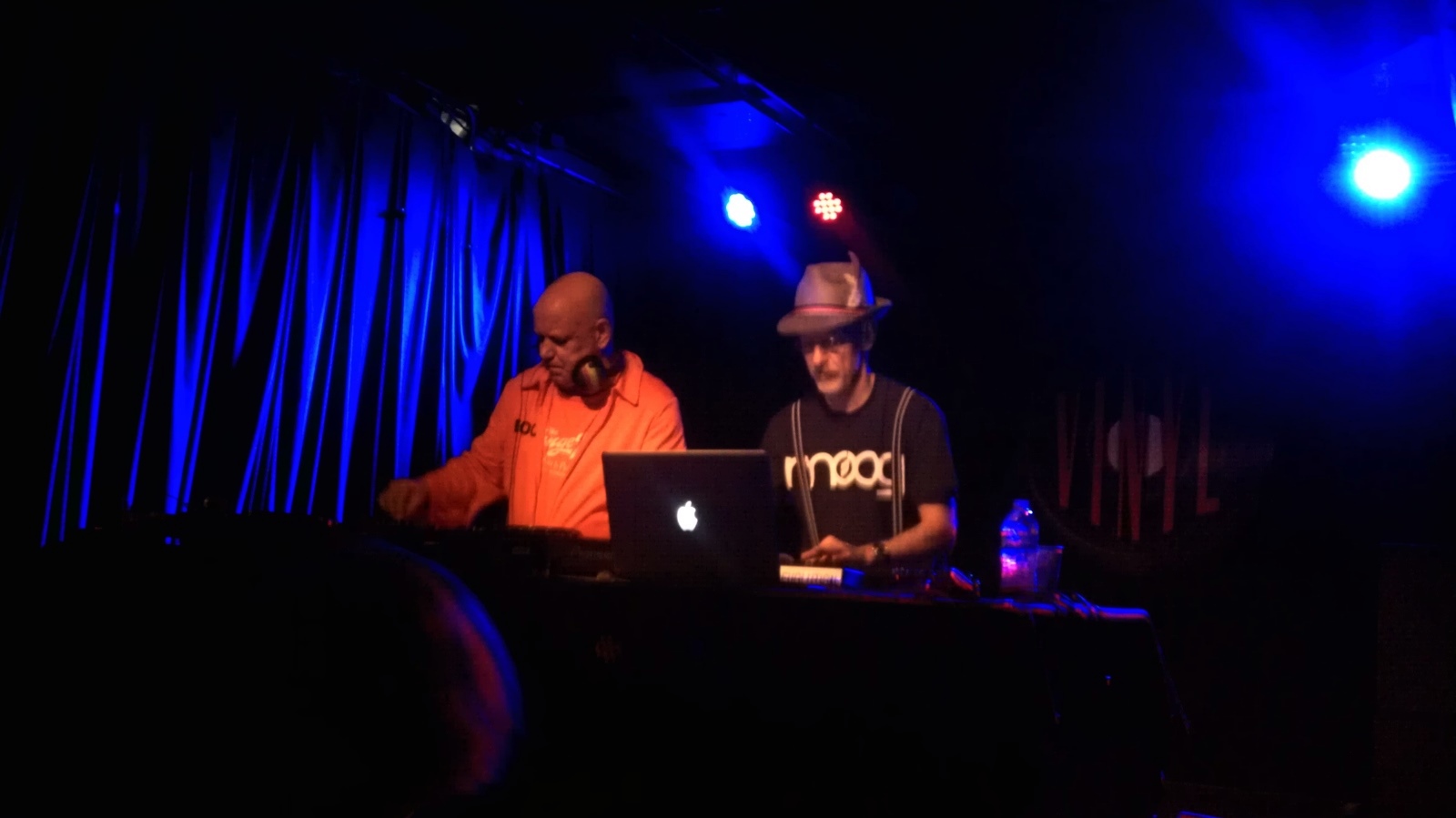

As the band played, a thoroughly entertaining video display was projected on a large screen set up to the right of the band, showing album logos, dancers, space and sci-fi themed film clips, old silent movies, and various other imagery.  It being Halloween, anywhere from two-thirds to three-fourths of the audience were in costume, although I suspect that an Orb concert might attract its fair share of costumed audience regardless of the date.  By and large, it looked like much like a classic 90s rave, complete with glow sticks. Combined with the trippy ambient music of The Orb, the costumed dancers and the video projections all combined to create an extremely other-worldly atmosphere.  It should also be noted that the audience was extremely well-behaved, polite, and cool, with nearly everyone wearing a blissed-out smile and making room at the front of the stage for dancers instead of trying to crowd the stage as at most shows.   People would tap me on the shoulder and say things like, "Dude, I saw them back in '95 at a festival with Underworld!," or dance with me for a few minutes, or just stand next to one another and share in our mutual appreciation of the evening. 

The Orb's two-hour set wrapped up around 11:00, and although the house lights stayed down for a long time as the audience called for an encore, cheering and clapping and chanting "Orb! Orb! Orb!", they never returned to the stage.  Several of us wondered what the point was of leaving the lights down after the set if they had no intention of performing an encore. 


But I actually really didn't mind all that much, as I had places to be.  Before I had bought my ticket for The Orb, I had purchased tickets to see Thurston Moore and his band Chelsea Light Moving at The Earl, so as soon as The Orb wrapped up their set at around 11:00, I left Vinyl in Midtown and drove over to East Atlanta Village  and The Earl.

Everything worked in my favor.  From Vinyl, I headed first up Peachtree and then back down Spring, jumping on the Connector at 14th (pardon the ATL ITP jargon).  Although East Atlanta Village was pretty busy on Halloween night, I lucked out finding a parking space almost immediately from the one car in an otherwise full parking lot pulling out just as I was pulling in.  I made it into The Earl by 11:15.


When I walked in, Moore was on stage tuning up, but the band had not yet started.  I had enough time to get a beer and find a spot to watch, and then Chelsea Light Moving began playing.
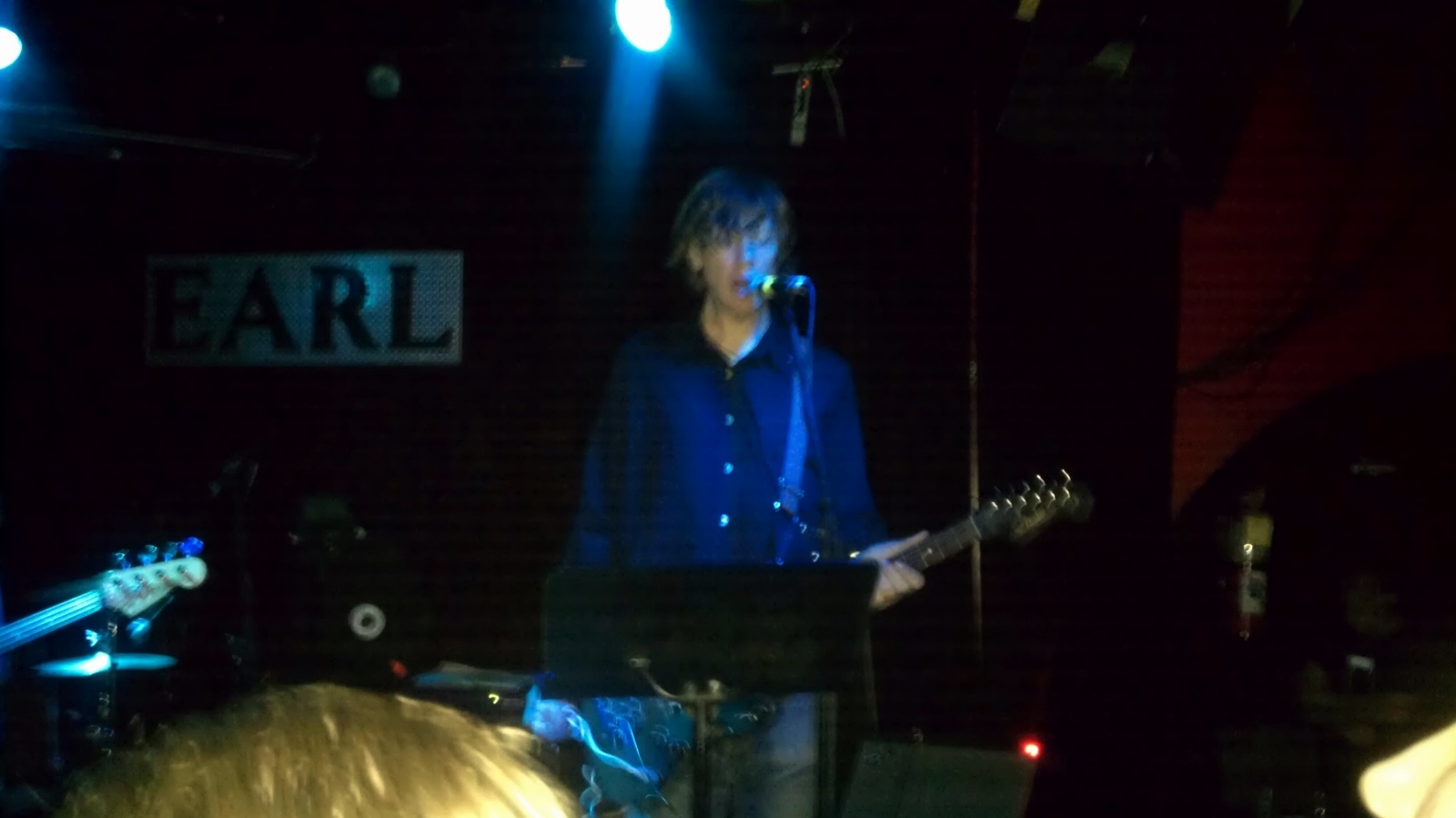

We've seen Chelsea Light Moving here back in March, and Thurston Moore performing under his own name at The Goat Farm following the release of his underrated Demolished Thoughts LP, but it's always a treat to see Moore perform and it Halloween night isn't the time to overindulge with two shows, then when is?  

As you can imagine, the edgy, angst-ridden music of Chelsea Light Moving was quite a contrast from The Orb's Little Fluffy Clouds. But change is good, and Moore played a great set, concentrating on songs from their debut album, but featuring a few new numbers as well. They played several of my favorites, including Burroughs (second song of the set), Groovy and Linda, and Empires of Time, but they never did get around to my favorite, Frank O'Hara Hit.


I imagine that with all of the entertainment options available on Halloween night, not limited to all the bands playing around town, there was a lot of competition for the audience, but I was still surprised at the relatively small size of the crowd at The Earl.  It was also interesting to note that very few people in the audience at The Earl were in costume, quite the contrast with the audience at Vinyl for The Orb.  

Chelsea Light Moving wrapped up their set around midnight, and played one short encore song, with bassist Samara Lubelski on violin, before calling it a night.

Wednesday, June 19, 2013

My Life As Music, Part I: 1954-1960


In 1954, Dwight D. Eisenhower was President and  the bombing of Hiroshima and Nagasaki a mere nine years earlier were fresher then in American's memories than the events of 9/11 are today.  I was born that year on the exact same day as the late Walter Payton of the Chicago Bears. Four years later, Thurston Moore (Sonic Youth, Chelsea Light Moving) was born on that same day.  But these are mere coincidences and not the point of this post.

In the year 1954, the landmark Brown v. the Board of Education decision overturned the policy of "separate but equal" conditions for different races.  Although the ruling turned out to be extremely difficult to enforce in the Southern United States, the civil rights movement had entered a new phase after Brown. 

Before I was born, R&B artists such as Fats Domino and Johnny Otis were creating exciting new music by speeding up the tempos and emphasizing the backbeat, but their music was not allowed to be played on many white-owned radio stations. However, artists and producers quickly recognized the commercial potential of the new music, and white performers were soon appropriating black music, a trend that still continues to this day (e.g., tUnE-yArDs and Macklemore & Ryan Lewis).

Bill Haley & His Comets are generally considered the earliest group of white musicians to bring the new music to the attention of white America.  In addition to the Brown decision, 1954 was also the year that Haley broke free from his former country-and-western style and recorded Chattanooga Choo Choo and Shake, Rattle and Roll, and more importantly, Thirteen Women (And Only One Man in Town), the latter featuring a now-more-famous B-side called (We're Gonna) Rock Around the Clock, widely regarded as the world's first rock 'n' roll recording. Not that there's any agreement on exactly what was the first rock 'n' roll song, nor will there likely ever be, but from late 1954 to late 1956, the first two years of my life, the group had nine singles in the Top 20, an accomplishment generally considered to be the birth of rock 'n' roll.

But the stand-out performer of the 1950s was not Bill Haley, but The King, Elvis Presley.  What people tend to forget, though, is that most of Elvis' early hits were covers of black R&B or blues songs, like That's All Right (a countrified arrangement of a blues number), Baby Let's Play House, Lawdy Miss Clawdy, and most notably Hound Dog, Presley's 1956 hit cover of an earlier (1952) recording by Willie Mae "Big Mama" Thornton.


Elvis' version now ranks No. 19 on Rolling Stone's list of The 500 Greatest Songs of All Time.  My young parents bought a copy of Hound Dog sometime on the late '50s, and it is the earliest recording that I can recall hearing, even though my parents didn't consider it appropriate entertainment for young children.  They were pleased that whenever the song came on, I would bay like a hound in protest, and to this day  whenever I hear the song, I still hear a howling voice somewhere in the back of my mind.  Nevertheless, I remember hearing my father sing along with the record late at night to my mother's amusement.  Hound Dog clearly excited my parents, but at my young age I didn't recognize the sexual nature of that excitement, although in retrospect I now note that my two sisters weren't conceived until after Hound Dog had been purchased. 

That excitement on the part of young white audiences over African-American music and rhythms inevitably provoked racist reactions in the 1950s, but before we judge that earlier generation too harshly, I saw the same thing happen again in the 1970s with racist and homophobic reactions to the advent of disco, and in the 1990s with racist reactions to the emergence of hip-hop.

Thus was the world into which I was born.  Segregation, a despicable vestige of even more abhorrent slavery, was formally outlawed, and rock 'n' roll, a new form of music created by white musicians appropriating black styles, started becoming popular.  I never lived in a time without rock 'n' roll music, and I never lived in a time of  legal apartheid in America. To put it another way (and I know how this sounds), neither rock 'n' roll nor racial integration in America ever existed without me in the world.

But periods of musical innovation tend not to last very long.  For example, by the time most people heard the psychedelic music that was coming out of Haight-Ashbury in 1967, the Summer of Love had long since been over.  Same with the first punk-rock explosion in New York in the 1970s and the indie-rock renaissance in the late 2000s.  By the time I entered kindergarten in September 1959, Elvis had joined the army and Little Richard had retired from performing to become a preacher.  Buddy Holly, The Big Bopper, and Ritchie Valens all died in a February 1959 plane crash on the infamous "Day The Music Died."  Jerry Lee Lewis became entangled in a scandal surrounding his marriage to his thirteen-year-old cousin, and Chuck Berry had been arrested on allegations concerning a 14-year-old Apache girl.  The Payola scandal implicated major music-industry figures in bribery and corruption charges and gave a sense that rock 'n' roll music was coming to an end.  The charts were soon dominated by syrupy love ballads, usually aimed at teenage girls. 

But all was not without hope.  On January 2, 1960, a charismatic young Senator, John F. Kennedy of Massachusetts, initiated his campaign for President of the United States.  There was an excitement in the early '60s air, a sense of possibility that anything was possible and that the best was yet to come.  There was talk of a "New Camelot," surf music began to emerge from California, and dances crazes like the Twist and the Watusi embodied the excitement everybody was feeling.

With a vigorous young leader like Kennedy as President, we wondered, what could possibly go wrong?

Sunday, March 10, 2013

Chelsea Light Moving, Talk Normal, and Merchandise at The Earl, March 8, 2013


I'm falling slightly behind in my concert posts, so I'll just keep things going until I catch back up.

Last Friday night, Thurston Moore brought his Chelsea Light Moving project to The Earl while on his way to Austin for SXSW, with Merchandise and Talk Normal in tow.  Once again, I had to drive from Birmingham, Alabama to Atlanta to see the show, but this time without the specter of having to drive back the next morning.  I'm back home now, at least for the time being.

The opening band, Tampa's Merchandise, kicked the evening off in a muscular fashion, playing an energetic post-punk/punk-pop hybrid, with elements of Echo-and-the-Bunnymen New Wave goth thrown into the mix for good measure.  Or something like that.  Here's a sample for you to be the judge.


For the last couple songs of their set, they brought an alto sax player on stage with them, lending a James White/Contortions-like bite to their sound.


Talk Normal were up next, introducing themselves with the line, "We're a Brooklyn band."  Guitarist/bassist Sarah Register and drummer/vocalist Andrya Ambro play a unique blend of driving noise rock, with feedback-drenched guitar tones and jarring rhythms.  To give you some idea of their performance, on the second or third song of their set, Ms. Ambro placed a guitar over her floor tom and played it by beating the strings with her drumsticks.  Their songs at times sounded tribal, other times primal, and always interesting.  Due more to the compatability of their sound than due to the similarities of their names, they should consider touring sometime with Portland's Talkdemonic.


The stage was lit with two red spotlights placed on the floor, rendering photography nearly impossible, so apologies in advance for the quality of these pictures.


Here's a picture from their Facebook page of all of their equipment "politely ejected out the back door" of The Earl after their set.


Headliners, of course, were Thurston Moore and Chelsea Light Moving.  Commenting on their March 2 set in Hoboken, NJ, NYC Taper noted ,
"I had to remind myself at several points during this show that the exuberant, youthful guitarist and vocalist on the cozy Maxwell’s stage in his band’s own t-shirt was a 54-year-old member of rock royalty who I had seen perform in front of crowds hundreds of times this size. Sonic Youth may be on hiatus or it may be gone, but Thurston will keep playing – and keep playing well – for as long as he’s breathing. Chelsea Light Moving, as a band, isn’t Sonic Youth, but it isn’t just a dim facsimile of it, either. With Samara Lubelski (a well-known solo artist and member of Thurston’s solo band) on bass, John Moloney (Sunburned Hand of the Man) on drums and Keith Wood (Hush Arbors, Wooden Wand) on guitar, Chelsea Light Moving has an accomplished cast and its own personality. In some ways, CLM feels more like SST-era Sonic Youth – younger, hungrier, rawer. It seems fun to be in this band, in a way that’s almost impossible in a more established one."
Chelsea Light Moving is more a real band with real songs than a Thurston Moore & Friends jam session.  As a bandleader, Thurston Moore was calm, engaging, relaxed, and free of expectations. Chelsea Light Moving stands as a great band in its own right, and as a second act, it’s a more than worthy one.  By their own description, "the band is ready to detonate any birthday party, wedding or hullaboo in any country, planet or stratosphere that doesn’t support right wing extremist NRA sucking bozo-ology."  Keeping true to their word, and prompted by a Brooklyn Vegan comments thread, the band recently played a birthday party in a basement at a house in Northhampton, Massachusetts (video below). 


Chelsea Light Moving delivered a great set at The Earl, opening with Burroughs (one of the first songs ever posted to this blog) and including all the songs from their debut album that I know, including Groovy and Linda, Lip, and Alighted, as well as Empires of Time (dedicated to Roky Erickson), some new material, and my personal favorite, Frank O'Hara Hit.

On a personal note, I have to point out that somehow I managed to wind up standing at the best possible spot in the whole club, right at the stage and directly in front of Mr. Moore.  Two feet from a modern rock legend.  The pictures below weren't shot with a telephoto lens - I had to go wide-angle on Mr. Moore's face to avoid documenting his dental work.


Friday, March 8, 2013

Chelsea Light Moving


This blog was born out of the feral energy of Velvet Underground, Chelsea Light Moving, and William S. Burroughs, so it's fitting that we finally get a chance this evening to hear Thurston Moore and his Chelsea Light Moving project at The Earl.

Thursday, November 22, 2012

Burroughs


I know that I'm skipping ahead by more than a few chapters, but there is a direct lineage from the music of the Velvet Underground to Thurston Moore's Chelsea Light Moving, and in honor of my Thanksgiving tradition, I want to post CLM's Burroughs.


A little William S. Burroughs goes a long way, of course, but this being Thanksgiving and all makes me want to indulge in a just a little more.  Director Gus Van Sant cast Burroughs as a character in his brilliant 1989 movie Drugstore Cowboy, but the role was really more of a elegiac tribute to the man than any element of the film's plot.  Someone stitched all of his scenes together into one clip, presented below.  With his Kansas accent and odd cadence and rhythms, Burroughs talked like almost no one else before or after, but he was also about the most honest, direct, and insightful individual you'd ever want to meet.  Just listen to his prophesy starting at about the 3:56 mark in the Drugstore Cowboy clip, and the wisdom evident in an excerpt from an interview with journalist Jurgen Ploog after the Cowboy clip.


Finally, here's a fascinating clip in which Burroughs explains not only his cut-up technique but also hints at possibilities for time travel and also foreshadows Steve Reich's early phasing experiments.  There's a direct  path from this spoken word piece to Reich to My Life In The Bush of Ghosts and to all of hip-hop.