The current Thurston Moore Group consists of ex-Sonic Youth Moore (duh), ex-Youth drummer Steve Shelley, My Bloody Valentine bassist Deb Googe, and guitarist James Sedwards. They have a new album coming out, By the Fire, featuring the track Hashish, which is described as “an ode to the narcotic of love in our shared responsibility to each other during this time.” The video is a compilation of footage from the band’s recent tour in Europe, “as well as clips from home during COVID lockdown safe in space with respect to the sacred healing truth of nature.”
The hotel's internet upload speed (or lack thereof) is preventing me form uploading yesterday's pictures to Flickr, but they will get up there eventually. Meanwhile, here are a few of the highlights from Day 2 of Hopscotch.
JENKS MILLER & ROSE CROSS NC
An improvisational set of experimental music to kick off (at least for me) the Three-Lobed Recordings day party.
LITTLE BLACK EGG BIG BAND
As you can see, the "Little Black Egg Big Band" is really Yo La Tengo with guest guitarists. Below is NPR's picture of the event, with your humble narrator in the lower left.
SUNBURNED HAND OF THE MAN
Psychedelic improv from a North Carolina band.
MV & EE
The first band of the day to feature bona-fide song structure, Vermont's MV & EE still elft a lot of room to jam out on their compositions.
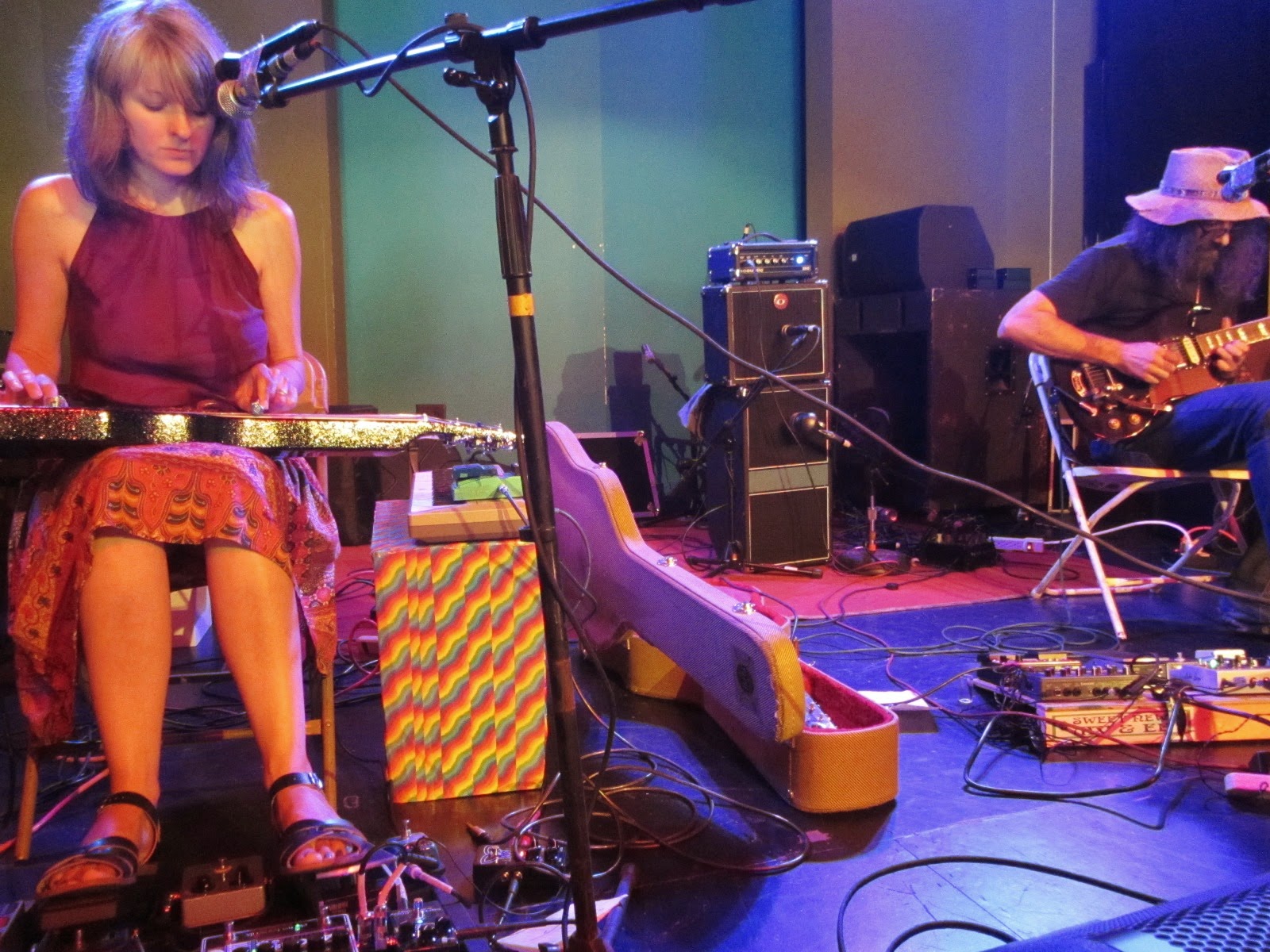
THURSTON MOORE & MARY LATTIMORE
Thurston Moore improvisational guitar noise and feedback, this time accompanied by a harp for some reason.
LONNIE WALKER
On the main stage, a local band got a big break opening for the next two acts.
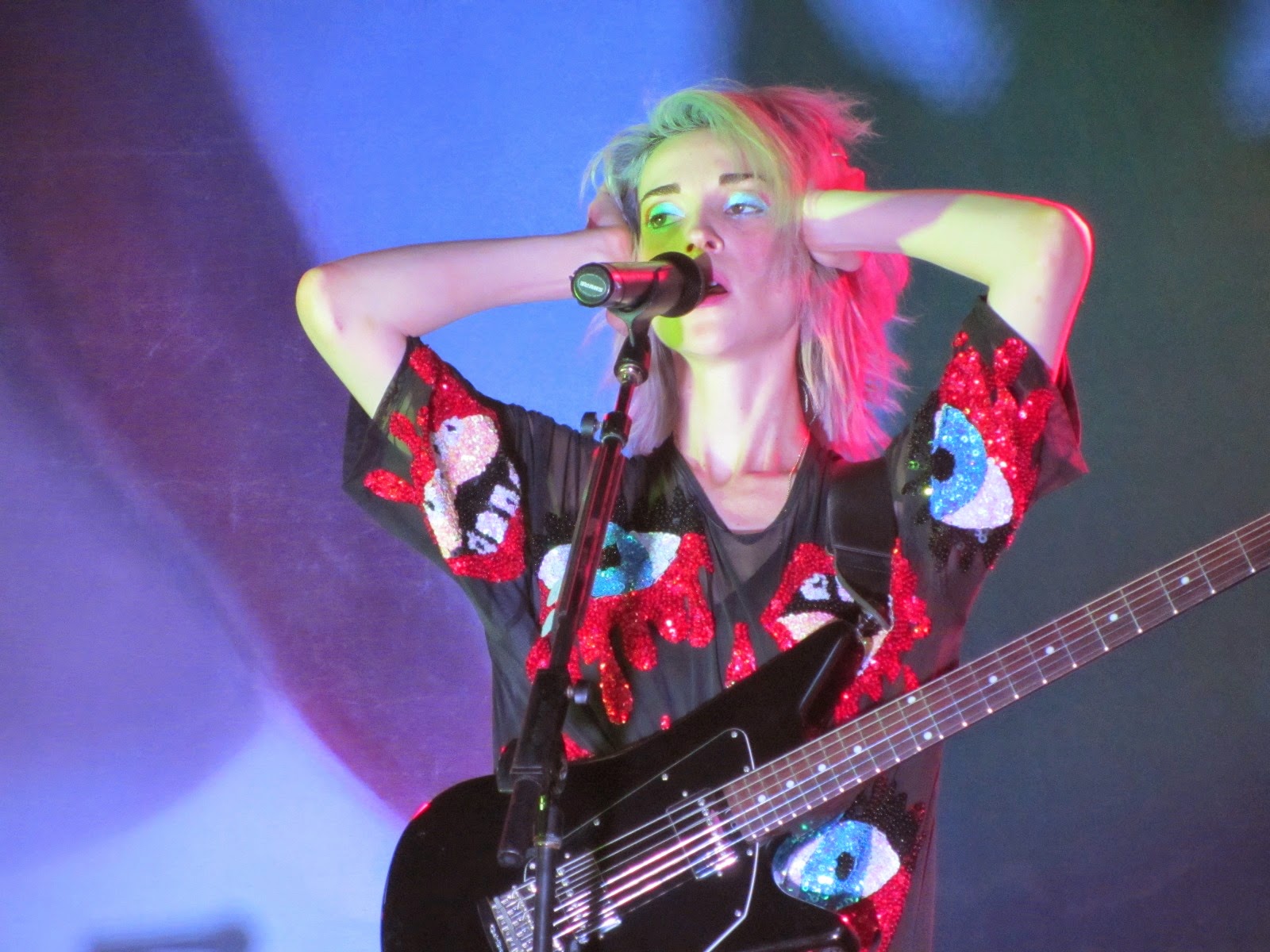
ST. VINCENT
Basically, the same show that she did at The Tabernacle in Atlanta earlier this year, which is not a bad thing at all.
SPOON
A very different set than their retrospective of past hits at the Shaky Knees Festival last May, since a new album has come out since then, and they played a nice mix of the old and the new.
LOAMLANDS
Truth in advertising: the festival description said Loamlands feature "crackling, serpentine electric guitaar leads, spiritual and emotional wondering, country twang, folk rollick, and rock volume," and that is exactly what Loamlands delivered.
MARK McGUIRE
Overlooped compositions straddling the boundary between new age and alt rock.
SUN KIL MOON
Did not want to be photographed, and there was a lot of drama and tension at the beginning of the set which shall be discussed at a later date, but the set ultimately developed into a fine performance of his moving, self-confessional, narrative songs.
Gotta get going - missing sets now even as I type. More to follow.
Today is July 25 and it's the last birthday of this sixth decade of my existence. In recognition of my birth 59 years ago in Mineola, New York and of an early childhood of idyllic summer weekends spent on Fire Island, and since this blog started with the music of Thurston Moore, I wanted to share the following written by Moore last July 25:
Today is July 25 and it's my birthday. I'm 54. This song is called Frank O'Hara Hit. And it's by this band I started called Chelsea Light Moving. Right now we're whipping around Europe playing some summer love-cry gigs. I wanted to release this song by the end of July because it's a meditation on that month through history in events that define a lot of what mytho-romanticizes my heart, both broken and blessed at the moment.
On July 25, 1965, Bob Dylan with the Paul Butterfield Blues Band delivered to rock n' roll the dissident soul of folk music and poetry. For many it was already a viable meeting but Dylan set it on fire for the world to see. And he was famously cursed and booed by the gatekeepers of old ways wariness. The song he sang was Phantom Engineer (later titled It Takes A Lot To Laugh, It Takes A Train To Cry).
On July 24, 1966, the NYC poet Frank O'Hara was struck by a dune buggy while hanging out on Fire Island, and died the next day. O'Hara knew poetry in all it's formalist glory and like John Cage's ear to music liberated it for writers for an unending time. In his essay Personism: A Manifesto (published in Leroi Jones' Yugen magazine in 1961) he writes, "I don't ... like rhythm, assonance, all that stuff. You just go on your nerve. If someone's chasing you down the street with a knife you just run, you don't turn around and shout, 'Give it up! I was a track star for Mineola Prep'...As for measure and other technical apparatus, that's just common sense: if you're going to buy a pair of pants you want them to be tight enough so everyone will want to go to bed with you. There's nothing metaphysical about it."
On July 26, 1943, Mick Jagger was born in Dartford, Kent, England and would become the 20th century's erotic pinup for the unsafety of teeny bop girls everywhere preaching the gospel soaked blues of African-American music that their parents were most likely frightened to death of. His skill in getting it and keeping it together and continuing to honor the magic that rocks the fuck out when Howlin' Wolf hit the mic is what inspires every tantalizing facet of real rock n' roll.
On July 29, 1966, our hero Bobby Dylan crashed his motorbike while taking it for a spin in Woodstock He had just recorded three lightning rod LPs (Bringing It All Back Home, Highway 61 Revisited, Blonde on Blonde), a book of writing (Tarantula) and was taking a breather between a just finished nine month world tour (where he was facing audiences half pissed at his "Judas!" betrayal of folk purity) and readying for sixty-four American gigs booked by money hog Albert Grossman. He was amphetamine skinny and breathing high-octane annunciation. He returned to us a man in control of his image and he provocatively crushed celebrity underfoot like a shitty Marlboro.
Let us kiss our lovers gently in July as the lathered sunrays of August take us into contemplation and a sweet trust to a future we will always fight for. In rock n roll, soul, tenderness and piety.
Thurston Moore,
Commune di Santo Stefano di Sessanio, Italy
July 25, 2012
In 1954, Dwight D. Eisenhower was President and the bombing of Hiroshima and Nagasaki a mere nine years earlier were fresher then in American's memories than the events of 9/11 are today. I was born that year on the exact same day as the late Walter Payton of the Chicago Bears. Four years later, Thurston Moore (Sonic Youth, Chelsea Light Moving) was born on that same day. But these are mere coincidences and not the point of this post.
In the year 1954, the landmark Brown v. the Board of Education decision overturned the policy of "separate but equal" conditions for different races. Although the ruling turned out to be extremely difficult to enforce in the Southern United States, the civil rights movement had entered a new phase after Brown.
Before I was born, R&B artists such as Fats Domino and Johnny Otis were creating exciting new music by speeding up the tempos and emphasizing the backbeat, but their music was not allowed to be played on many white-owned radio stations. However, artists and producers quickly recognized the commercial potential of the new music, and white performers were soon appropriating black music, a trend that still continues to this day (e.g., tUnE-yArDs and Macklemore & Ryan Lewis).
Bill Haley & His Comets are generally considered the earliest group of white musicians to bring the new music to the attention of white America. In addition to the Brown decision, 1954 was also the year that Haley broke free from his former country-and-western style and recorded Chattanooga Choo Choo and Shake, Rattle and Roll, and more importantly, Thirteen Women (And Only One Man in Town), the latter featuring a now-more-famous B-side called (We're Gonna) Rock Around the Clock, widely regarded as the world's first rock 'n' roll recording. Not that there's any agreement on exactly what was the first rock 'n' roll song, nor will there likely ever be, but from late 1954 to late 1956, the first two years of my life, the group had nine singles in the Top 20, an accomplishment generally considered to be the birth of rock 'n' roll.
But the stand-out performer of the 1950s was not Bill Haley, but The King, Elvis Presley. What people tend to forget, though, is that most of Elvis' early hits were covers of black R&B or blues songs, like That's All Right (a countrified arrangement of a blues number), Baby Let's Play House, Lawdy Miss Clawdy, and most notably Hound Dog, Presley's 1956 hit cover of an earlier (1952) recording by Willie Mae "Big Mama" Thornton.
Elvis' version now ranks No. 19 on Rolling Stone's list of The 500 Greatest Songs of All Time. My young parents bought a copy of Hound Dog sometime on the late '50s, and it is the earliest recording that I can recall hearing, even though my parents didn't consider it appropriate entertainment for young children. They were pleased that whenever the song came on, I would bay like a hound in protest, and to this day whenever I hear the song, I still hear a howling voice somewhere in the back of my mind. Nevertheless, I remember hearing my father sing along with the record late at night to my mother's amusement. Hound Dog clearly excited my parents, but at my young age I didn't recognize the sexual nature of that excitement, although in retrospect I now note that my two sisters weren't conceived until after Hound Dog had been purchased.
That excitement on the part of young white audiences over African-American music and rhythms inevitably provoked racist reactions in the 1950s, but before we judge that earlier generation too harshly, I saw the same thing happen again in the 1970s with racist and homophobic reactions to the advent of disco, and in the 1990s with racist reactions to the emergence of hip-hop.
Thus was the world into which I was born. Segregation, a despicable vestige of even more abhorrent slavery, was formally outlawed, and rock 'n' roll, a new form of music created by white musicians appropriating black styles, started becoming popular. I never lived in a time without rock 'n' roll music, and I never lived in a time of legal apartheid in America. To put it another way (and I know how this sounds), neither rock 'n' roll nor racial integration in America ever existed without me in the world.
But periods of musical innovation tend not to last very long. For example, by the time most people heard the psychedelic music that was coming out of Haight-Ashbury in 1967, the Summer of Love had long since been over. Same with the first punk-rock explosion in New York in the 1970s and the indie-rock renaissance in the late 2000s. By the time I entered kindergarten in September 1959, Elvis had joined the army and Little Richard had retired from performing to become a preacher. Buddy Holly, The Big Bopper, and Ritchie Valens all died in a February 1959 plane crash on the infamous "Day The Music Died." Jerry Lee Lewis became entangled in a scandal surrounding his marriage to his thirteen-year-old cousin, and Chuck Berry had been arrested on allegations concerning a 14-year-old Apache girl. The Payola scandal implicated major music-industry figures in bribery and corruption charges and gave a sense that rock 'n' roll music was coming to an end. The charts were soon dominated by syrupy love ballads, usually aimed at teenage girls.
But all was not without hope. On January 2, 1960, a charismatic young Senator, John F. Kennedy of Massachusetts, initiated his campaign for President of the United States. There was an excitement in the early '60s air, a sense of possibility that anything was possible and that the best was yet to come. There was talk of a "New Camelot," surf music began to emerge from California, and dances crazes like the Twist and the Watusi embodied the excitement everybody was feeling.
With a vigorous young leader like Kennedy as President, we wondered, what could possibly go wrong?
I'm falling slightly behind in my concert posts, so I'll just keep things going until I catch back up.
Last Friday night, Thurston Moore brought his Chelsea Light Moving project to The Earl while on his way to Austin for SXSW, with Merchandise and Talk Normal in tow. Once again, I had to drive from Birmingham, Alabama to Atlanta to see the show, but this time without the specter of having to drive back the next morning. I'm back home now, at least for the time being.
The opening band, Tampa's Merchandise, kicked the evening off in a muscular fashion, playing an energetic post-punk/punk-pop hybrid, with elements of Echo-and-the-Bunnymen New Wave goth thrown into the mix for good measure. Or something like that. Here's a sample for you to be the judge.
For the last couple songs of their set, they brought an alto sax player on stage with them, lending a James White/Contortions-like bite to their sound.
Talk Normal were up next, introducing themselves with the line, "We're a Brooklyn band." Guitarist/bassist Sarah Register and drummer/vocalist Andrya Ambro play a unique blend of driving noise rock, with feedback-drenched guitar tones and jarring rhythms. To give you some idea of their performance, on the second or third song of their set, Ms. Ambro placed a guitar over her floor tom and played it by beating the strings with her drumsticks. Their songs at times sounded tribal, other times primal, and always interesting. Due more to the compatability of their sound than due to the similarities of their names, they should consider touring sometime with Portland's Talkdemonic.
The stage was lit with two red spotlights placed on the floor, rendering photography nearly impossible, so apologies in advance for the quality of these pictures.
Here's a picture from their Facebook page of all of their equipment "politely ejected out the back door" of The Earl after their set.
Headliners, of course, were Thurston Moore and Chelsea Light Moving. Commenting on their March 2 set in Hoboken, NJ, NYC Taper noted ,
"I had to remind myself at several points during this show that the exuberant, youthful guitarist and vocalist on the cozy Maxwell’s stage in his band’s own t-shirt was a 54-year-old member of rock royalty who I had seen perform in front of crowds hundreds of times this size. Sonic Youth may be on hiatus or it may be gone, but Thurston will keep playing – and keep playing well – for as long as he’s breathing. Chelsea Light Moving, as a band, isn’t Sonic Youth, but it isn’t just a dim facsimile of it, either. With Samara Lubelski (a well-known solo artist and member of Thurston’s solo band) on bass, John Moloney (Sunburned Hand of the Man) on drums and Keith Wood (Hush Arbors, Wooden Wand) on guitar, Chelsea Light Moving has an accomplished cast and its own personality. In some ways, CLM feels more like SST-era Sonic Youth – younger, hungrier, rawer. It seems fun to be in this band, in a way that’s almost impossible in a more established one."
Chelsea Light Moving is more a real band with real songs than a Thurston Moore & Friends jam session. As a bandleader, Thurston Moore was calm, engaging, relaxed, and free of expectations. Chelsea Light Moving stands as a great band in its own right, and as a second act, it’s a more than worthy one. By their own description, "the band is ready to detonate any birthday party, wedding or hullaboo in any country, planet or stratosphere that doesn’t support right wing extremist NRA sucking bozo-ology." Keeping true to their word, and prompted by a Brooklyn Vegan comments thread, the band recently played a birthday party in a basement at a house in Northhampton, Massachusetts (video below).
Chelsea Light Moving delivered a great set at The Earl, opening with Burroughs (one of the first songs ever posted to this blog) and including all the songs from their debut album that I know, including Groovy and Linda, Lip, and Alighted, as well as Empires of Time (dedicated to Roky Erickson), some new material, and my personal favorite, Frank O'Hara Hit.
On a personal note, I have to point out that somehow I managed to wind up standing at the best possible spot in the whole club, right at the stage and directly in front of Mr. Moore. Two feet from a modern rock legend. The pictures below weren't shot with a telephoto lens - I had to go wide-angle on Mr. Moore's face to avoid documenting his dental work.
One of my favorite concerts of the year was held during MusicFest Northwest, but wasn't actually a part of MFNW, when My Morning Jacket played an outdoor show in McMenamin's Edgefield in rural Troutdale, Oregon. Some magic combination of MMJ's epic jams, the beautiful setting, the sunset, and the fact that my being there was totally unplanned (my itinerary had me seeing Kishi Bashi in the basement Doug Fir Lounge over in Portland) all made it a very special show. The quality of this fan video isn't professional but it isn't all that bad either, and it does give a fairly good impression of what the show was like. As I recall, this number was about a third of the way into the set.
I don't like to rank anything as "Concert of the Year," as that's such a relative title, and many shows deserve top ranking for one aspect of the performance or another. But, because such things are traditional at the end of the year, here in chronological order are some of my favorite concerts of 2012:
Akron/Family, Drunken Unicorn, January 14
Thurston Moore, The Goat Farm, February 8
Allo Darlin' & The Wave Pictures, 529, April 28
Damien Jurado, The Earl, May 23
Sonic Generator performing Steve Reich's Drumming, The Goat Farm, July 27
Dirty Projectors, Variety Playhouse, August 9
M83, Bumbershoot, Seattle, September 3
Low, Bumbershoot, Seattle, September 3
Black Mountain, Doug Fir Lounge (MFNW), Portland, Oregon, September 8
My Morning Jacket, McMenamin's Edgefield, Troutdale, Oregon, September 9
Animal Collective, The Tabernacle, September 30
David Byrne & St. Vincent, Cobb Energy Center, Marietta, Georgia, October 3
In Thursday's interview, William S. Burroughs talked about visionaries and forward thinkers such as Galileo, Cezanne, and James Joyce, and how their work and vision was not only initially misunderstood, but attacked, censured, and ridiculed until the shock of the new had finally worn off, and how, once the public's eyes had been opened, the creative process marches on.
Here's Bob Dylan at the Newport Folk Festival with the Paul Butterfield Blues Band, "delivering rock n' roll to the dissident soul of folk music and poetry." Note the booing at the end of the set, as the audience was not yet capable of understanding the new version Dylan was presenting of their beloved protest music. As Thurston Moore noted years later, "For many it was already a viable meeting, but Dylan set it on fire for the world to see."
It's easy now to dismiss those who were booing the "electric" Bob Dylan as being short-sighted and provincial, but one has to understand that they legitimately believed they were defending and preserving the purity of their cherished folk music. Rock music fans today who react in a negative way to hip-hop, to electronic dance music, and to other cutting-edge forms of music are really no different from that critical audience of 1965, and rather than ridicule Dylan's hecklers, they should recognize them as their aesthetic predecessors.
Like A Rolling Stone has been hailed by many critics as the single most important American song of the 20th Century, and while that's certainly debatable, it's delivery and impact on arrival was unquestionably one of the most revolutionary. According to NPR, Dylan had finished recording the song just 10 days before the Newport festival. "As usual, he didn't bring arrangements or charts to the recording session. He came in, taught the musicians the song and then they recorded take after take, experimenting with different tempos.
The version of Like a Rolling Stone that ultimately got released was six minutes long, almost twice as long as most standard pop songs. That made it difficult for radio disc jockeys to program, but they did."
Well, some did. AM radio station WABC, the dominant Top 40 station in New York at the time, didn't play it, and I never heard the song, or any Dylan for that matter, on the radio, although I was familiar with Dylan's name and the reputation. I didn't actually hear his music until sometime around 1967 or '68, to the best of my recollection, when I purchased a copy of Bob Dylan's Greatest Hits unheard, based solely on reputation and the press. I was only 13 or maybe 14 years old, but I can still remember putting that record on for the very first time and hearing that nasal voice on Side 1, Track 1, singing "Well, they'll stone ya when you're trying to be so good. they'll stone ya just like they said they would", and thinking to myself, "What the hell is this?" I had never heard anything like that before and his sound took some time for me to get used to, but I stuck with it and by the end of Side 2 (Just Like A Woman) it had become my favorite album and I was forever changed.
Very shortly after that, around '68 and '69, FM radio came to my attention, first WABC-FM, a more album-oriented version of it's Top 40, AM sister, and then later WNEW, which departed even further from the commercial mainstream into what was then called "underground rock." The FM stations played Dylan, as well as the Beatles and the Stones, Jimi Hendrix, the Doors, Jefferson Airplane, and The Who. It was the start of a musical exploration for me, a journey which I'm still on to this day.
Not to get too far ahead of myself, but it was on WNEW where I first heard King Crimson (In the Court of the Crimson King), which led me even further down the rabbit hole. Over the next five or six years, the voyage took me away from the radio altogether and to the import bins at the back on the record stores, where King Crimson led me to Robert Fripp, and Robert Fripp led me to Fripp and Eno, and Fripp and Eno led me to Brian Eno, and then things really began to get interesting.
I know that I'm skipping ahead by more than a few chapters, but there is a direct lineage from the music of the Velvet Underground to Thurston Moore's Chelsea Light Moving, and in honor of my Thanksgiving tradition, I want to post CLM's Burroughs.
A little William S. Burroughs goes a long way, of course, but this being Thanksgiving and all makes me want to indulge in a just a little more. Director Gus Van Sant cast Burroughs as a character in his brilliant 1989 movie DrugstoreCowboy, but the role was really more of a elegiac tribute to the man than any element of the film's plot. Someone stitched all of his scenes together into one clip, presented below. With his Kansas accent and odd cadence and rhythms, Burroughs talked like almost no one else before or after, but he was also about the most honest, direct, and insightful individual you'd ever want to meet. Just listen to his prophesy starting at about the 3:56 mark in the Drugstore Cowboy clip, and the wisdom evident in an excerpt from an interview with journalist Jurgen Ploog after the Cowboy clip.
Finally, here's a fascinating clip in which Burroughs explains not only his cut-up technique but also hints at possibilities for time travel and also foreshadows Steve Reich's early phasing experiments. There's a direct path from this spoken word piece to Reich to My Life In The Bush of Ghosts and to all of hip-hop.