1993 was another one of those transitional years - he started the year still living upstate New York but spent most of the year living in Pittsburgh and ended the year living back in Atlanta again.
It was definitely time for him to leave New York State. He was still working for the same environmental engineering firm that he had joined in Atlanta in 1984 and when they made him an offer to finally leave Albany and manage their struggling Pittsburgh office, he leaped on the opportunity and rented a loft apartment in a former doll factory in Pittsburgh's Shadyside neighborhood. Pittsburgh felt satisfyingly urban after his six years upstate, but it was a bad year for the economy and the office there barely broke even. By the end of the year, he had to make the difficult decision to close the office and by December he had successfully found other jobs for the staff there. He wound up living back in Atlanta again, working at the firm's flagship office.
He had liked it in Pittsburgh, though. He liked it that the city had so many different neighborhoods, each of which was distinct and unique from the others. His neighborhood, Shadyside had a jazz club, The Balcony, that featured Big Band Night every Wednesday. The South Side seemed to be composed almost entirely of bars and clubs and was a fun place to visit. The Strip District (not what you think - it was characterized by strips of warehouses) had a pair of nightclubs, Rosebud and Metropol, that featured live music.
It was around this time that an alternative form of hip-hop had started to emerge. Atlanta's Arrested Development came out with their debut album 3 Years, 5 Months & 2 Days in the Life Of. . . the year before, and A Tribe Called Quest had released The Low End Theory the year before that. Us3's overtly jazz-influenced Hand on the Torch would drop later that year, but the summer of 1993 was the season for Digable Planet's Reachin' (A New Refutation of Time and Space) and itssingle Rebirth of Slick (Cool Like Dat). The band featured three rappers, Ladybug, Doodlebug, and Butterfly (aka Ishmael Butler, who would later go on to form Shabazz Palaces), and their record sampled some of his favorite jazz artists, including Don Cherry, Sonny Rollins, Art Blakey, Herbie Mann, Herbie Hancock, Grant Green, and Rahsaan Roland Kirk.
Anyway, it was all pretty heady stuff, and it was probably the period he was most involved in hip-hop. He even got to see Digible Planets perform that year at Rosebud in the Strip District. So, if he had to pick one single song to represent the year 1993, which otherwise had so many changes of address that music sort of faded into the background, it would have to be Cool Like Dat, because to this day every time he hears that song, he remembers the smoky interior of Rosebud and his brief time living in Pittsburgh.
Last night's performances at Terminal West had a strong yin-yang quality to them: fire and ice, or the sun and the moon. The meeting of the three disparate bands brought to mind the 13th Hexagram of the I Ching, Thung Zăn, or "Union of Men," with its imagery of the starry but dark heavens above and bright fires or the Sun below.
The opening band, Atlanta's DeadCAT (not to be confused with Seattle's palindromic TacocaT), started things off by balancing the two forces, combining the dark and the bright. The band features a rock solid rhythm section and vocals with the reverb so heavy that not only were the lyrics undecipherable, so was most of the stage banter. The result was a strange and distorted (but in a good way) set of garage psych-rock. The bass and drums moved the feet, the vocals opened the mind.
This was actually my third time seeing the next act, Seattle's Shabazz Palaces, but oddly my first time seeing them at night. I previously saw them in a daytime performance at Bumbershoot 2011, and then again opening just before sunset for My Morning Jacket at McMenamin's Edgefield in lovely Troutdale, Oregon during MFNW 2012. I've seen the band's Ishmael Butler perform with Thee Satisfaction at Bumbershoot 2012 (coincidentally on the same day is saw TacocaT), and going way back in the time machine, I saw Butler perform as Butterfly with the Digable Planets at Pittsburgh's Rosebud back around 1993 (sorry, no link to that pre-internet performance). Admittedly the last two were evening performances, but then again, they weren't Sahabazz Palaces performances either.
Anyhow, last night, Shabazzz Palaces played on a nearly dark stage, with just a couple spotlights roving the perimeter of the stage and the audience, as was fitting for their artistic and avant garde take on hip hop. A duo, the band transcends the usual hip-hop convention of one MC and one DJ, with both Butler and multi-instrumentalist Tendai 'Baba' Maraire handling vocals, electronics, and percussion, although Butler dominates the vocals and Maraire the percussion. This is a dark, spooky form of hip hop, perfect for late night listening, the spacey, upper trigram of the Thung Zănhexagram. For the record, their nearly 45 minute set was the best that I've heard yet from this innovative band.
The bright, lower part of the hexagram was provided by the indie pop of Shabazz Palaces' Sub Pop label - and tour mates, Portland's The Helio Sequence.
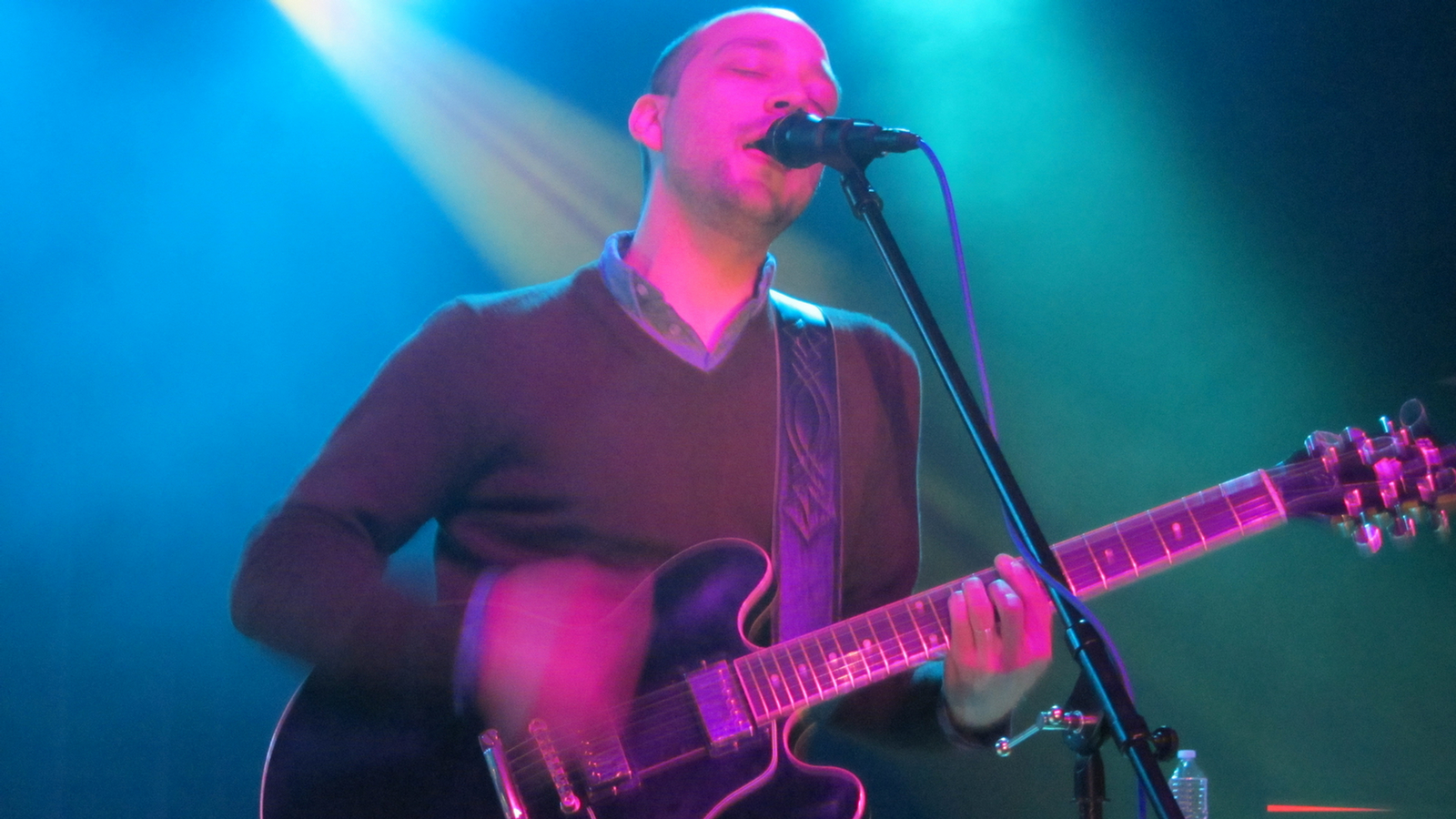
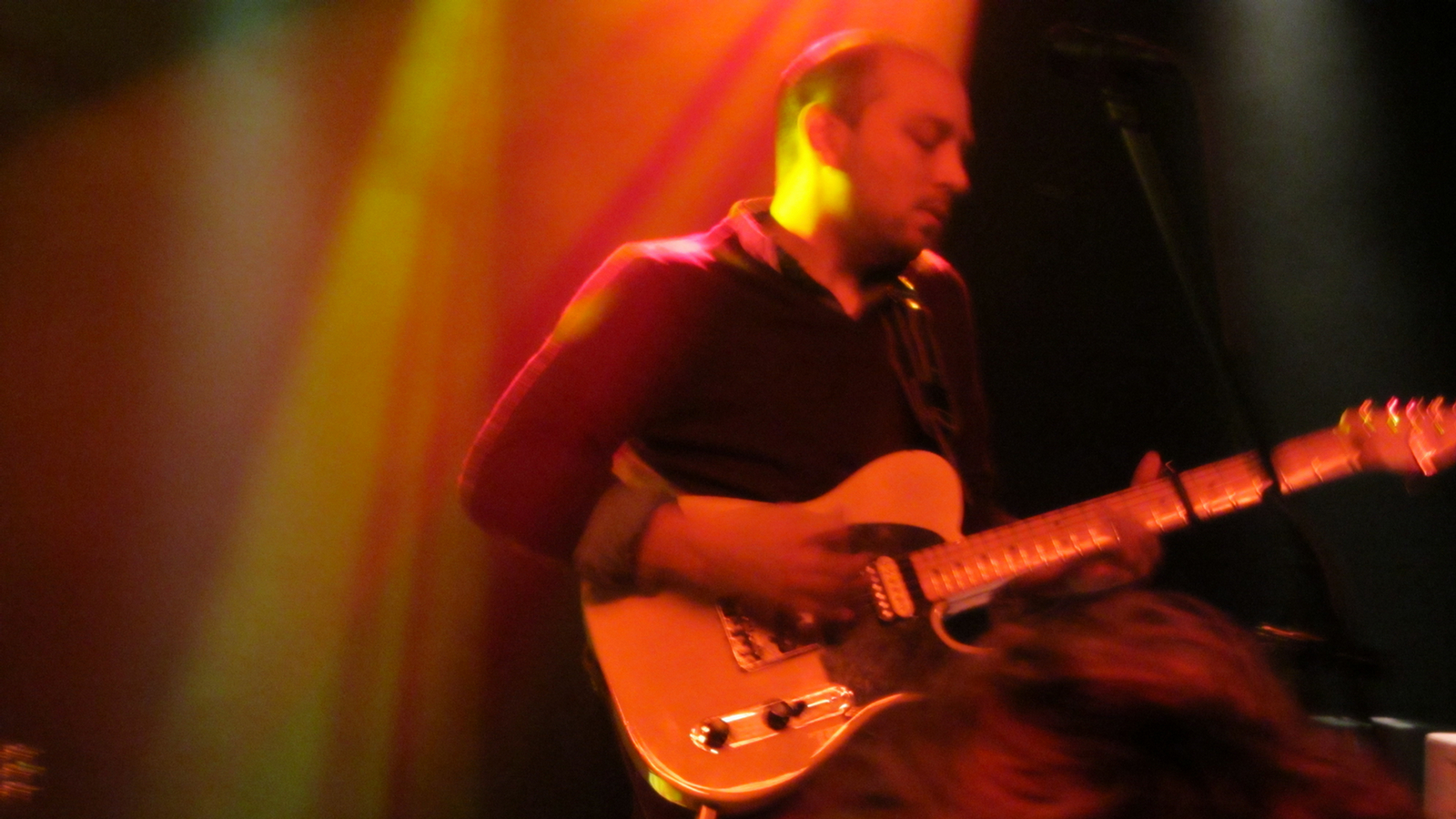
The Helio Sequence are touring for the first time in four years behind their first album, Negotiations, in as long a time. The band consists solely of guitarist/singer Brandon Summers and drummer Benjamin Weikel, who, it's been noted, may quite possibly be the happiest looking drummer on the face of the planet. Taking the stage with only two guitars, a drum kit, and Weikel's laptop, it's hard to believe the amount of music they're capable of generating. I have no quarrel with, and in fact rather enjoy, the Black Keys stripped-down rock using the same instrumentation, but The Helio Sequence produces a spacious wall of sound that someone just listening to a recording might mistake for a much fuller band. I kept watching to see how the magic was done, but couldn't figure out how Summers got so many simultaneous lines out of his guitar.
As befitting their sunnier sound, the Terminal West stage was more fully illuminated for the Helio Sequence set, which provided a luminous counterpoint to the dark Shabazz Palaces set, the yin to the yang, the lower trigram that completed Thung Zăn.
For their encore, The Helio Sequence provided two folk-pop sounding songs, featuring Summers on harmonica.
I couldn't help but notice a large turnover in the audience after Shabazz Palaces' set. At least three-quarters of the people standing around me for Shabazz Palaces left after their set, and the people surrounding me during The Helio Sequence had either been further back in the audience (I had managed to find a spot in the second row from the stage) or had just arrived. I don't know if it's the difference between hip hop and rock, between the avant garde and the mainstream, or a racial distinction (this is, after all, still Georgia), but it's nevertheless unfortunate that there are those who's personal feng shui is still not balanced between the light and the dark.
In his commentary on Thung Zăn ("Union of Men"), Deng Ming-Dao notes that in our present era, we isolate ourselves from one another and allow our society to stratify into different classes. It is hard to remember that a true community, a true Union of Men, should be as easy as growing plants or sailing down a river. As easy as enjoying music together. In fact, a community that is hard to assemble or that must be maintained by coercion is not a true community.